|
 |
 |
|
Red Squirrels and Woodland Management Conifer Forests - the future for red squirrels. It is clear that grey squirrels are the major threat to reds. Forunately, however, greys do not appear to like conifer forests because the trees offer limited food supply. The good news is that reds seem able to survive in these forests. Therefore, setting up conifer forests as refuge sites for RED SQUIRRELS is a major focus for Red Alert NW.
In refuges Red Alert NW will focus on carrying out a detailed monitoring programme for each site and will work with woodland owners to ensure that the selected management practices are sympathetic to the needs of RED SQUIRRELS. Red Alert NW will also manage grey squirrel control schemes in 'buffer zones' surrounding each forest refuge. The recommended age structure of a conifer woodland for the benefit of red squirrels is 30% at 0-15 years, 30% 15-30 years and 40% over 30 years. This ensures a continuity in seed production for the squirrels. At least 50-60% of the wood should be of seed-producing age (i.e. over 15 years). Ideally there should be areas of long-term retention. The species of conifer most preferred by red squirrels are
A mixture of tree species is important to reduce the impact of poor cone years in particular species. Sitka spruce (Picea sitchensis) and Douglas fir (Psuesdotsuga menziesii) are less valued than the above species, but can be encouraged in small patches alongside the above as they are not favoured by grey squirrels.
|
| ||||||||||||||||||||||||||||||||||||||||||||||||||||||
|
|
Site supported by the Lake District Tourism &
Conservation Partnership Site designed & developed by http://www.voodoo.uk.com |



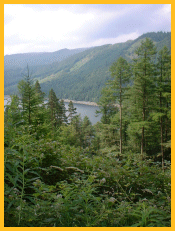 Refuge
sites is the best long-term strategy for RED SQUIRREL conservation, and
Red Alert NW is amongst the forerunners of the scheme. Setting up a forest
as a RED SQUIRREL refuge site requires considerable resources. Not all
are accessible to the public, but
Refuge
sites is the best long-term strategy for RED SQUIRREL conservation, and
Red Alert NW is amongst the forerunners of the scheme. Setting up a forest
as a RED SQUIRREL refuge site requires considerable resources. Not all
are accessible to the public, but